MENTOR
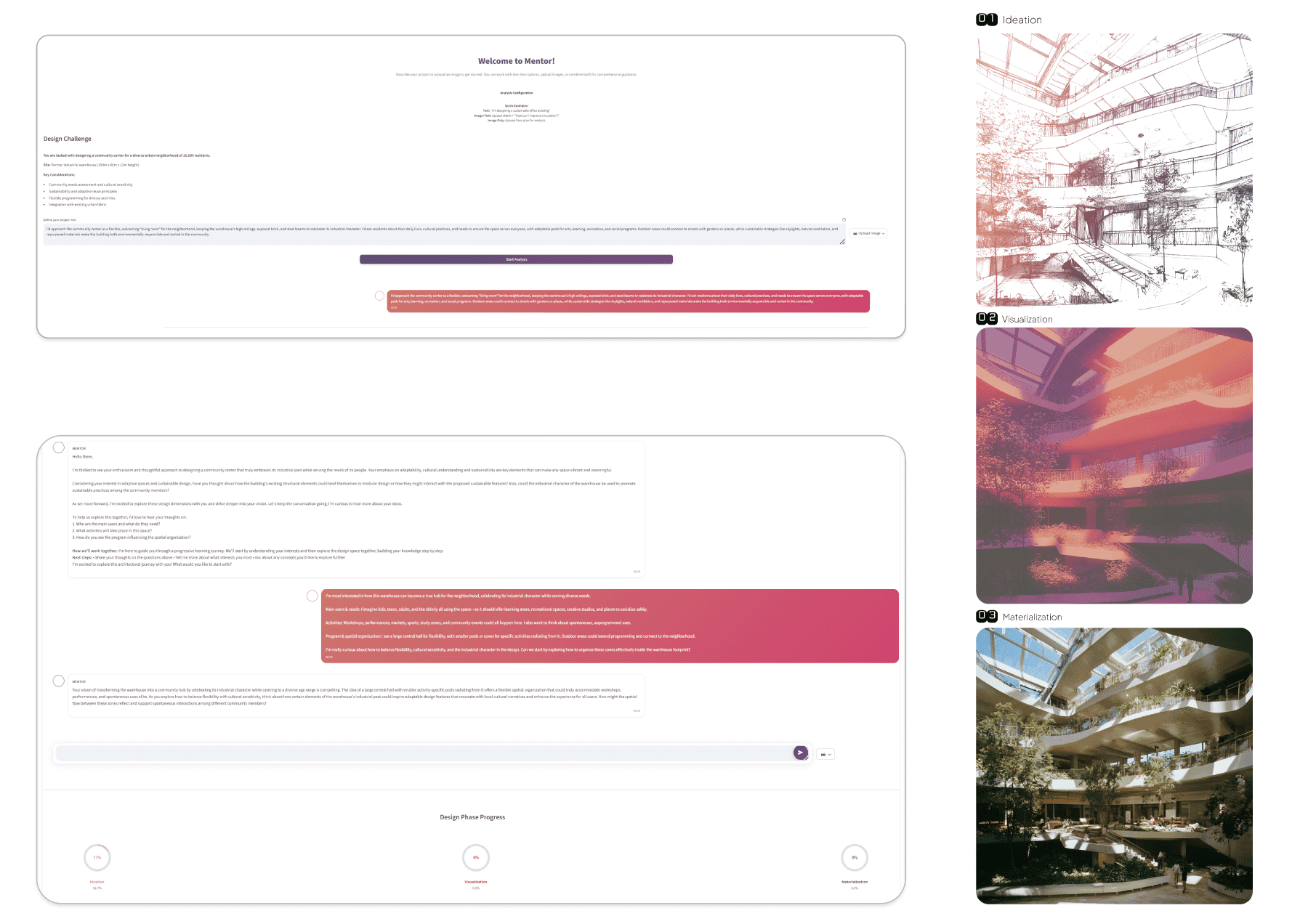
A multimodal AI teaching system for reflective architectural learning.
MENTOR is an AI-powered educational system designed to support deeper cognitive engagement in architectural education. Rather than functioning as a question-answering assistant, MENTOR guides students through structured reasoning, dialogue, and visual interpretation to encourage reflection, discovery, and independent thinking.
The Story
Developed and evaluated over nine weeks, the system integrates large language models, vision-language models, and agent-based orchestration to scaffold learning across conceptual, spatial, and technical dimensions. MENTOR was benchmarked against a GPT-only baseline, with results demonstrating improved engagement, reduced cognitive offloading, and increased depth of design reasoning.
System Architecture
MENTOR is built as a coordinated multi-agent system, where each agent supports a distinct pedagogical role.
Core Agents
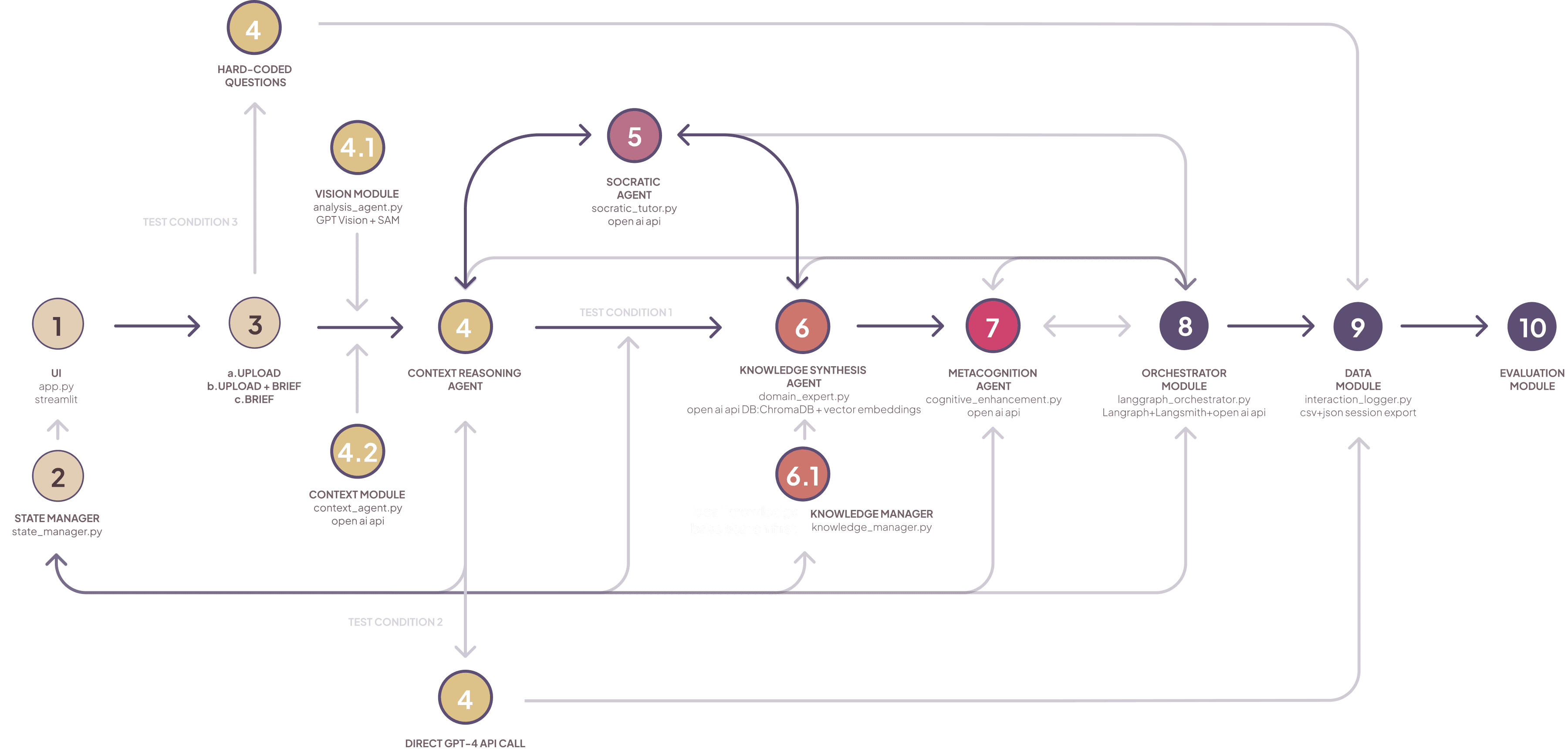
What this diagram says
Stages in order: 1 UI (app.py, Streamlit). 2 State manager (state_manager.py). 3 Upload, upload with brief, or brief alone. 4 Context reasoning agent, fed by the vision module (analysis_agent.py, GPT Vision and SAM) and the context module (context_agent.py). 5 Socratic agent (socratic_tutor.py). 6 Knowledge synthesis agent (domain_expert.py, ChromaDB and vector embeddings) with the knowledge manager (knowledge_manager.py). 7 Metacognition agent (cognitive_enhancement.py). 8 Orchestrator module (langgraph_orchestrator.py, LangGraph, LangSmith). 9 Data module (interaction_logger.py, CSV and JSON session export). 10 Evaluation module. Test condition 1 runs the full agent chain, test condition 2 a direct GPT-4 API call, and test condition 3 a set of hard-coded questions.
- Context Reasoning Agent. Interprets user input and situational context, acting as the entry point for all interactions.
- Knowledge Synthesis Agent. Connects ideas across domains, synthesizing theory, precedent, and technical knowledge.
- Socratic Dialogue Agent. Drives questioning, reflection, and conceptual exploration through guided prompts.
- Cognitive Enhancement Agent. Regulates cognitive load, pacing, and depth of engagement.





Orchestration
The workflows are implemented in LangGraph.
The Context Reasoning Agent routes interactions through single-agent or multi-agent coordination paths, including sequential, parallel, and adaptive flows. A synthesizer stage merges agent outputs into a coherent educational response.
Models.
- Microsoft Magma for vision-language reasoning
- GPT-4 Turbo and Claude 3.5 Sonnet for layered interpretation and dialogue
Knowledge Infrastructure
MENTOR’s Domain Expert relies on a hybrid Retrieval-Augmented Generation pipeline.
The pipeline runs in four stages:
- Document ingestion. A local PDF repository, text extraction with PyMuPDF, cleaning and preprocessing, then smart chunking with overlaps.
- Vector store. Persistent storage in ChromaDB, embedded with sentence transformers.
- Search strategies. Semantic search on vector similarity, keyword matching on text, query expansion into enhanced terms, and context analysis of user intent, merged into a single hybrid result.
- Knowledge synthesis. Retrieved passages are formatted for readability and citations are tracked, producing a multi-source response.
Educational safeguards.
- Pedagogical filtering reformats retrieved content for learning contexts
- Progressive disclosure reduces extraneous cognitive load
- Citation tracking returns sources in APA, MLA, or Chicago style
- Results are deduplicated and scored based on authority, relevance, and pedagogical suitability
The design argument underneath all of it is a contrast between two postures an AI tutor can take.
| The Oracle | The Catalyst | |
|---|---|---|
| The core transaction | Student asks, AI delivers information. Measures success by answer accuracy. “How quickly can I solve your problem?” | Student thinks, AI deepens thinking. Measures success by thinking quality. “How can I make your problem-solving stronger?” |
| The outcome design | Fastest path to correct answers. Reduces friction and effort. End goal: task completion. | Deliberate cognitive resistance. Maintains productive struggle. End goal: skill development. |
| The interaction dynamic | Positions itself as the knowledge authority. Student becomes the receiver. Creates a dependency loop: question, answer, next question. | Positions the student as the thinker. AI becomes the challenger. Creates a growth loop: attempt, reflection, deeper attempt. |
| What it optimizes for | Knowledge transfer, performance optimization. | Cognitive development, capability building. |
Learning Framework
The system is structured around three learning phases, each with distinct objectives and agent roles.
- Phase 1: Ideation. Focuses on creativity, conceptual exploration, and questioning. Led by the Socratic Dialogue Agent, with minimal technical constraints.
- Phase 2: Visualization. Bridges ideas with spatial representation. Balances creative inquiry and technical input using multimodal interaction and analysis support.
- Phase 3: Materialization. Emphasizes technical knowledge, system integration, and professional practice. Guided primarily by the Domain Expert Agent and real-world constraints.
A weighted completion formula values questioning, conceptual clarity, and response quality, encouraging balanced progression across phases.
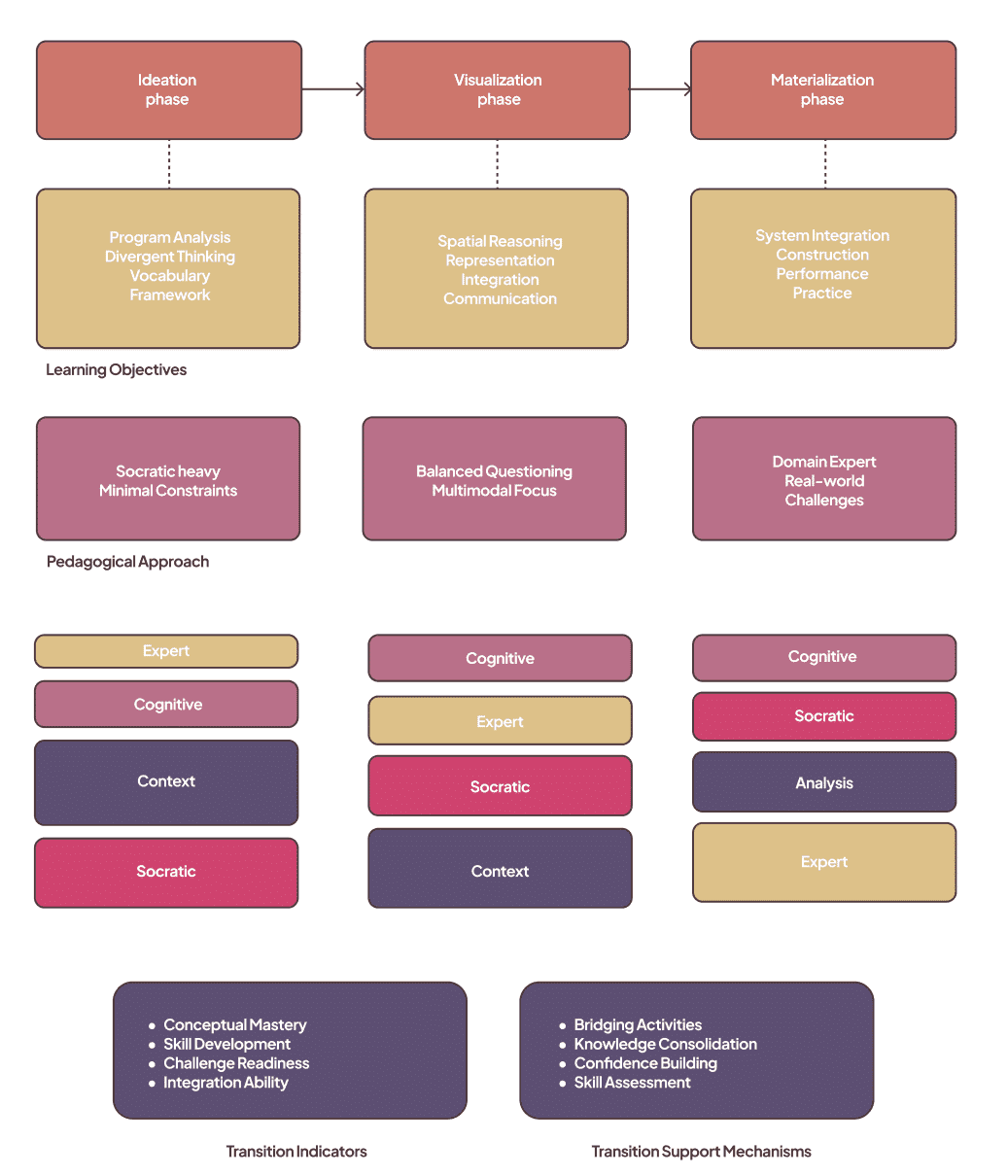
What this diagram says
Ideation aims at program analysis, divergent thinking, vocabulary and framework, taught Socratic-heavy with minimal constraints. Visualization aims at spatial reasoning, representation, integration and communication, with balanced questioning and a multimodal focus. Materialization aims at system integration, construction, performance and practice, led by the Domain Expert against real-world challenges. Transition indicators: conceptual mastery, skill development, challenge readiness, integration ability. Transition support: bridging activities, knowledge consolidation, confidence building, skill assessment.
Interactivity
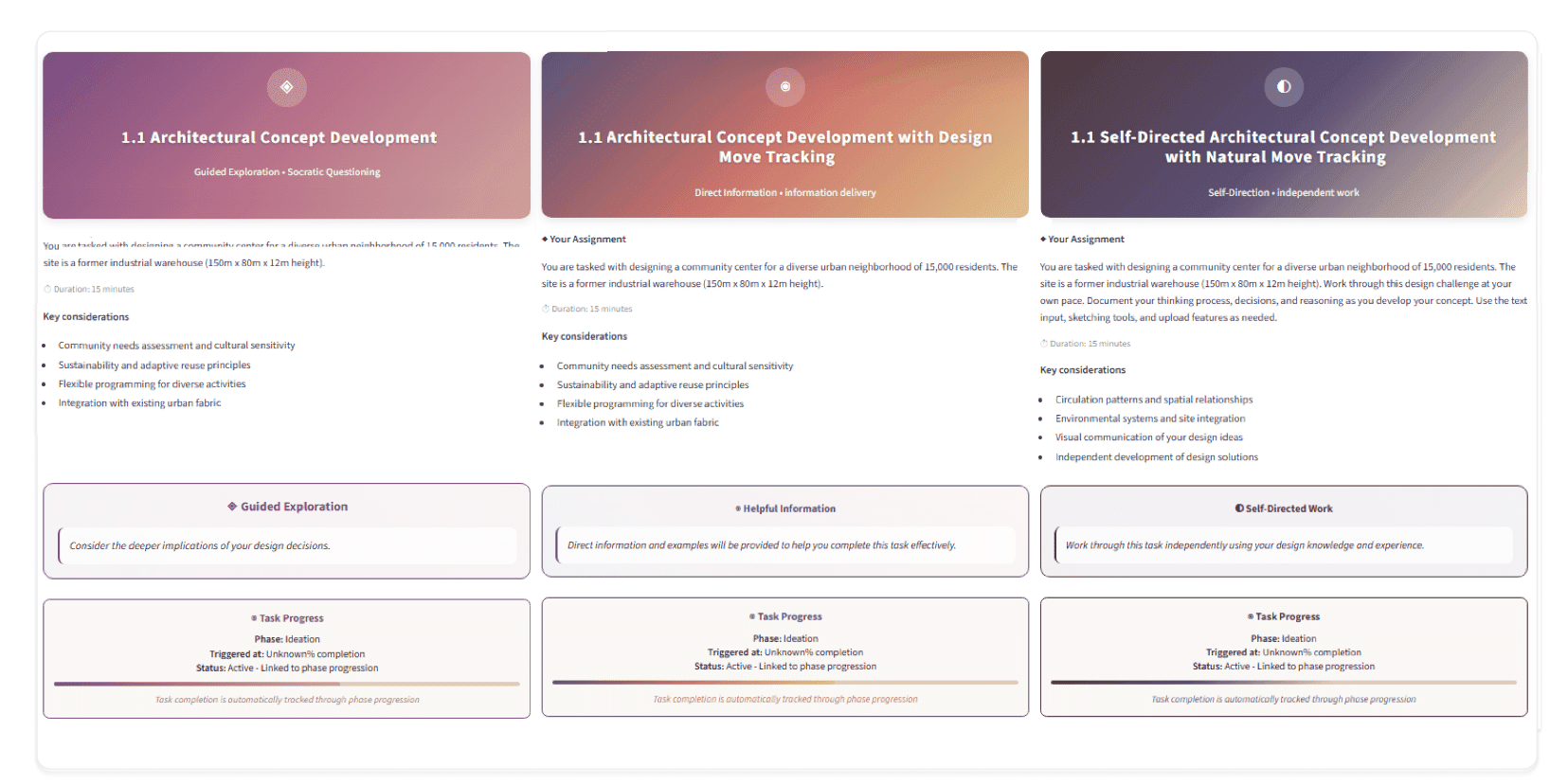
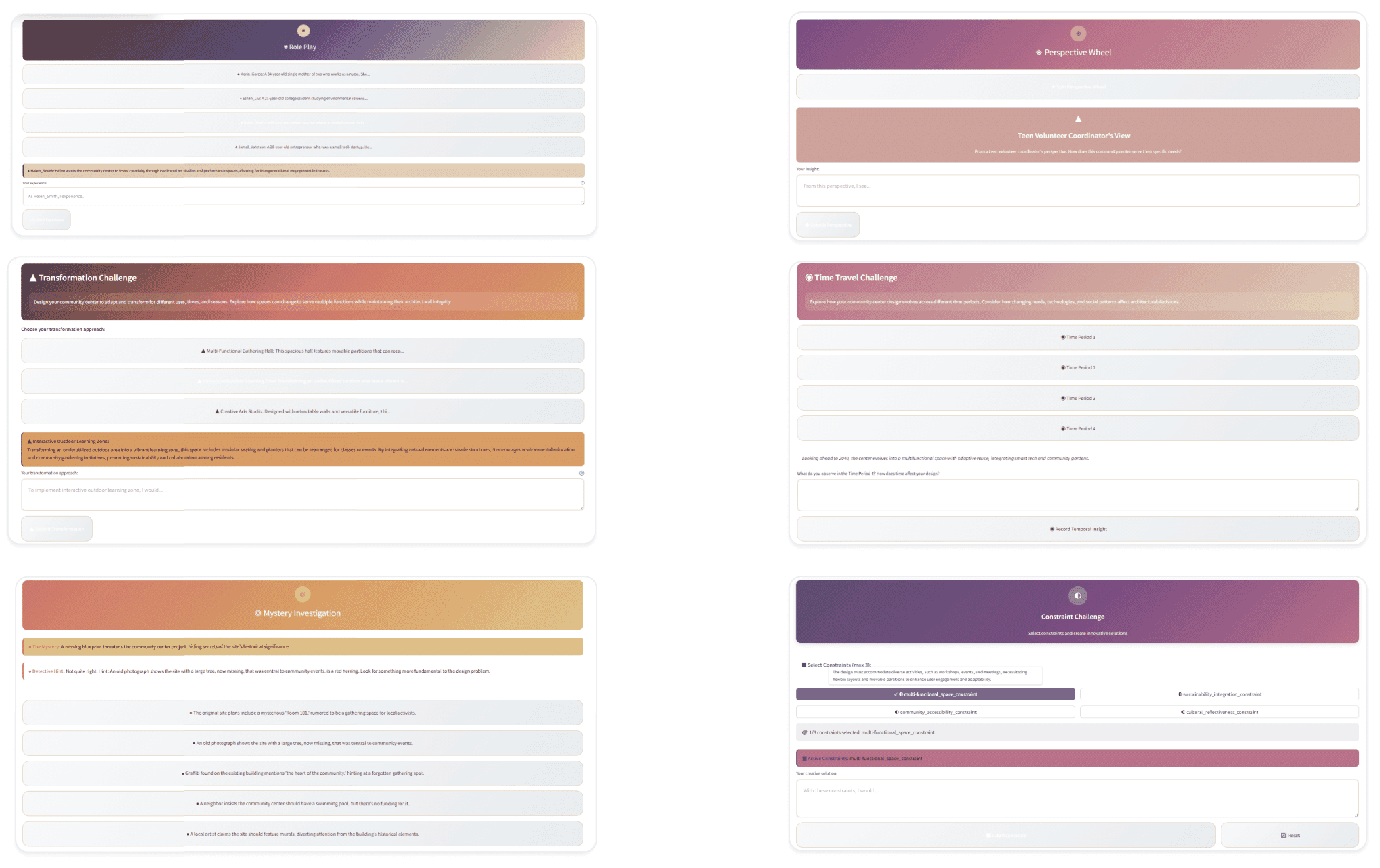
Task generation. MENTOR generates adaptive challenges aligned with each learning phase:
- Open-ended exploration in ideation
- Spatial reasoning and representation in visualization
- Real-world technical constraints in materialization
Image generation. Visual outputs translate abstract reasoning into diagrams, spatial layouts, and performance visualizations, reinforcing connections between concept and form.
Gamification. Progress metrics, phase completion formulas, and challenge-based learning maintain engagement. Learners advance through levels tied to ideation, visualization, and materialization, reinforcing both creativity and rigor.
Evaluation and Benchmarking
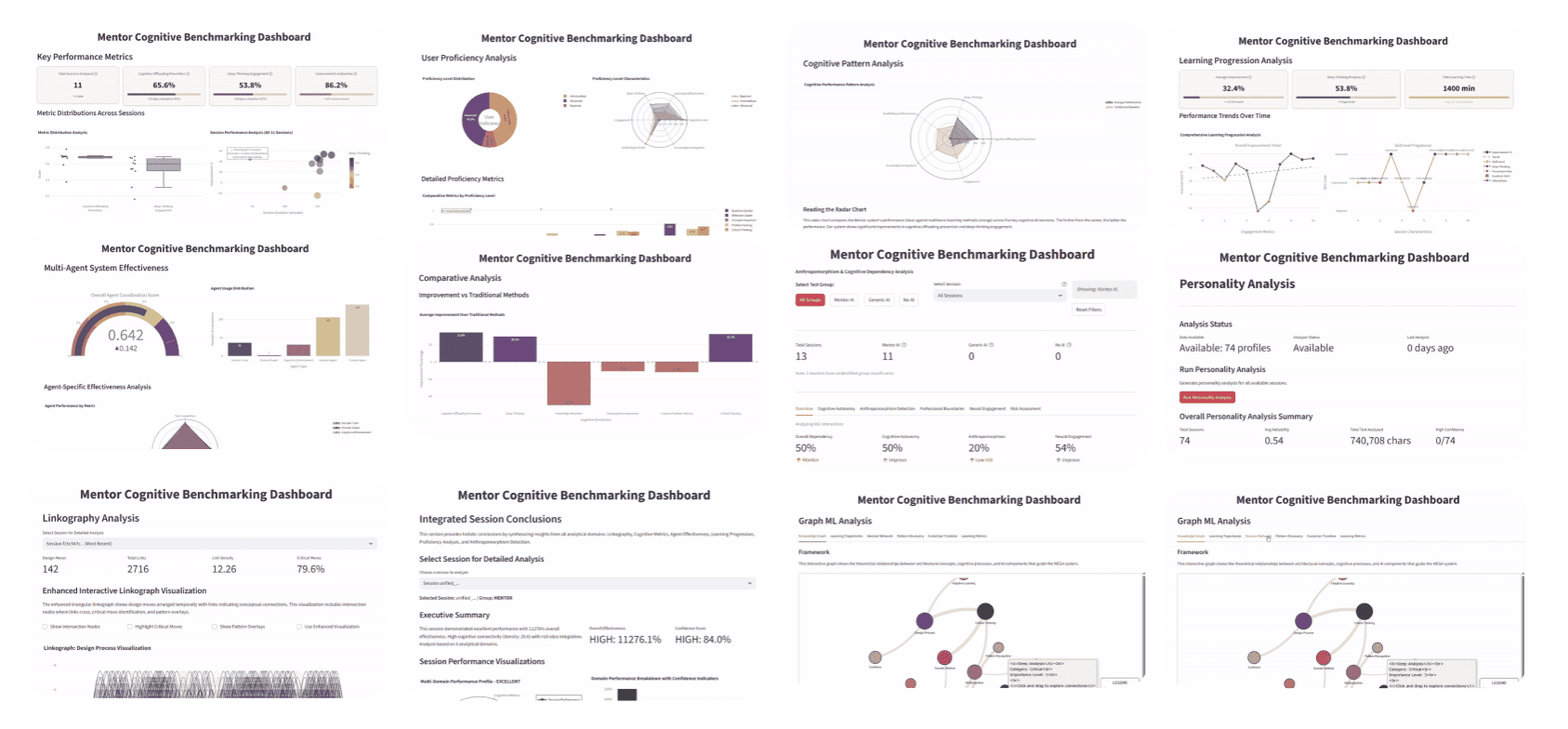
Cognitive analysis. Student interactions are logged and transformed into interaction graphs. Metrics include:
- Cognitive offloading prevention
- Depth of thinking
- Design move connectivity
Automated fuzzy linkography identifies critical moves and knowledge gaps.
Machine learning integration.
- Graph Neural Networks detect higher-order cognitive patterns
- Ensemble classifiers assess proficiency levels
- Statistical validation using mixed-effects models, ANOVAs, and Bayesian hierarchical analysis
Dashboards visualize learning progress, agent performance, and cognitive metrics in real time.
Results
MENTOR demonstrated measurable improvements over a GPT-only baseline.
- 84.7% cognitive offloading prevention rate
- 73.9% deeper thinking engagement rate
Students spent more time reasoning through decisions, articulating intent, and reflecting on alternatives rather than accepting generated answers.
MENTOR shows how multimodal, agent-based AI systems can function as cognitive scaffolds rather than content generators. By structuring dialogue, vision, and knowledge retrieval around pedagogical goals, the system supports reflective, discovery-based learning in architectural education.
MENTOR is designed to help students think through design decisions, not around them.
Project developed in collaboration with Seda Soylu and Biel Pitman. You can read the original article on the IAAC blog, or the published paper on Zenodo.