The Perch
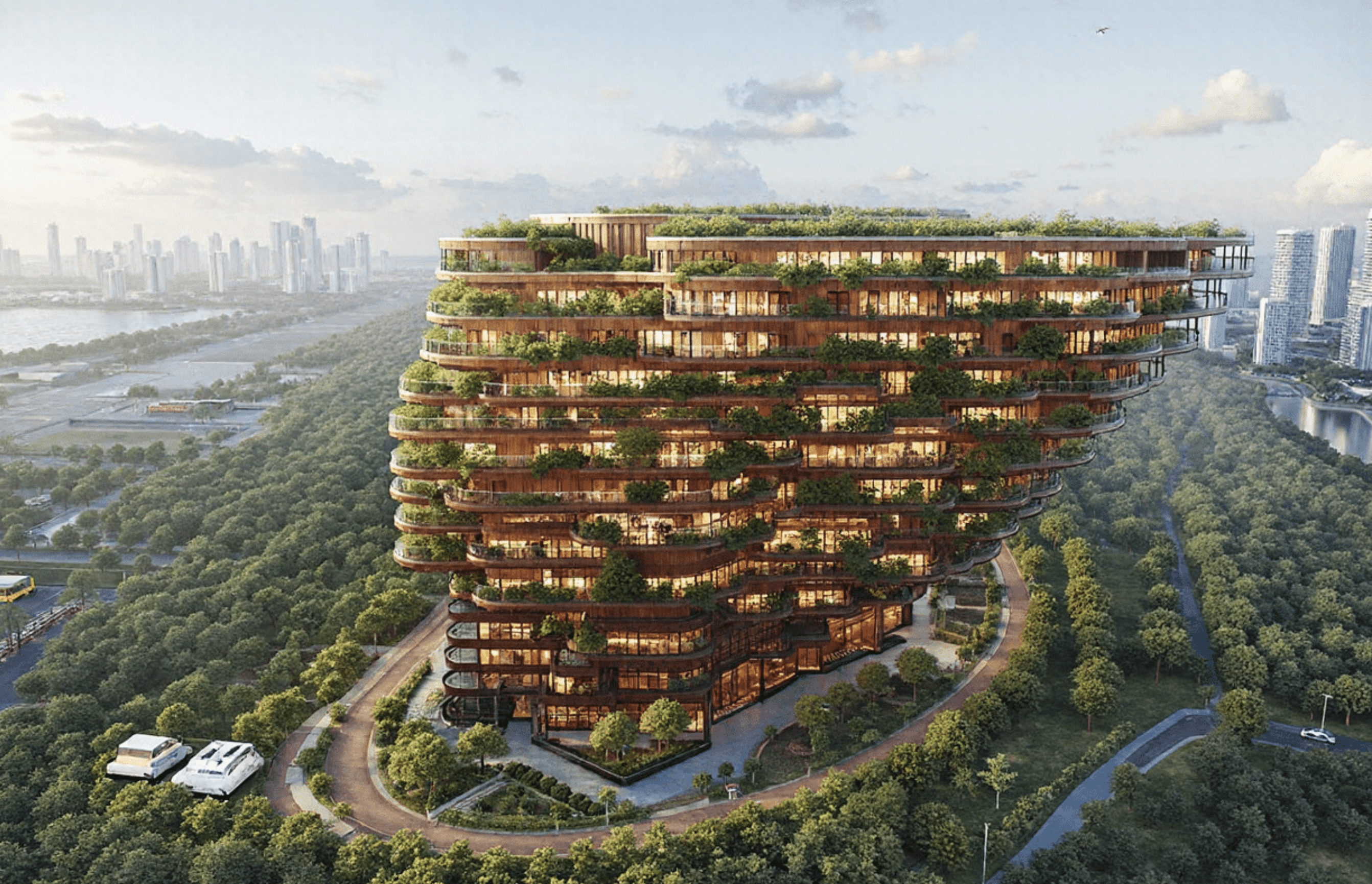
A generative mixed-use building system for adaptable urban living.
The Perch is a generative building typology that prioritizes adaptability and long-term flexibility over fixed layouts. Built on a stable 6m by 6m structural grid, the system allows internal partitions, programs, and circulation to shift and reconfigure without compromising structural integrity.
Core Principle
Rather than treating buildings as static objects, The Perch frames architecture as a reconfigurable system capable of responding to changing spatial, social, and environmental demands over time. The framework provides durability and order, while internal elements adapt in response to light, use, occupancy, and programmatic change.
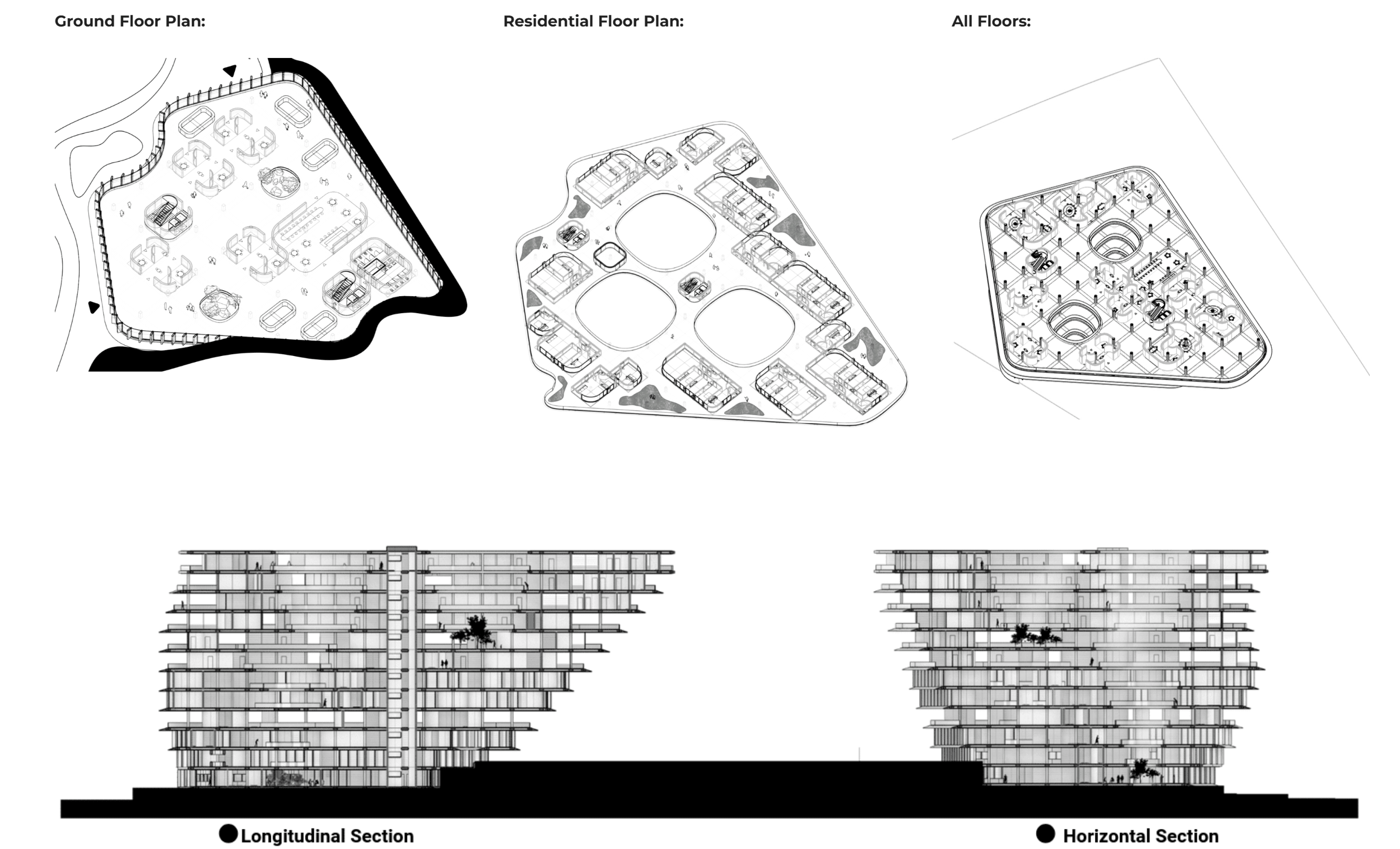
Form, Modules, and Aggregation
Form Finding
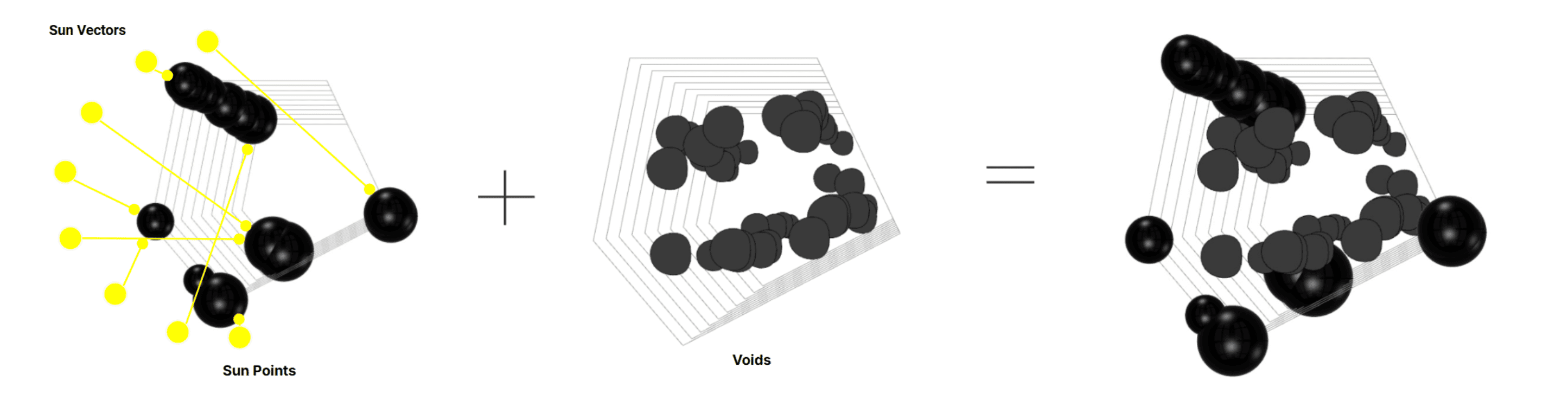
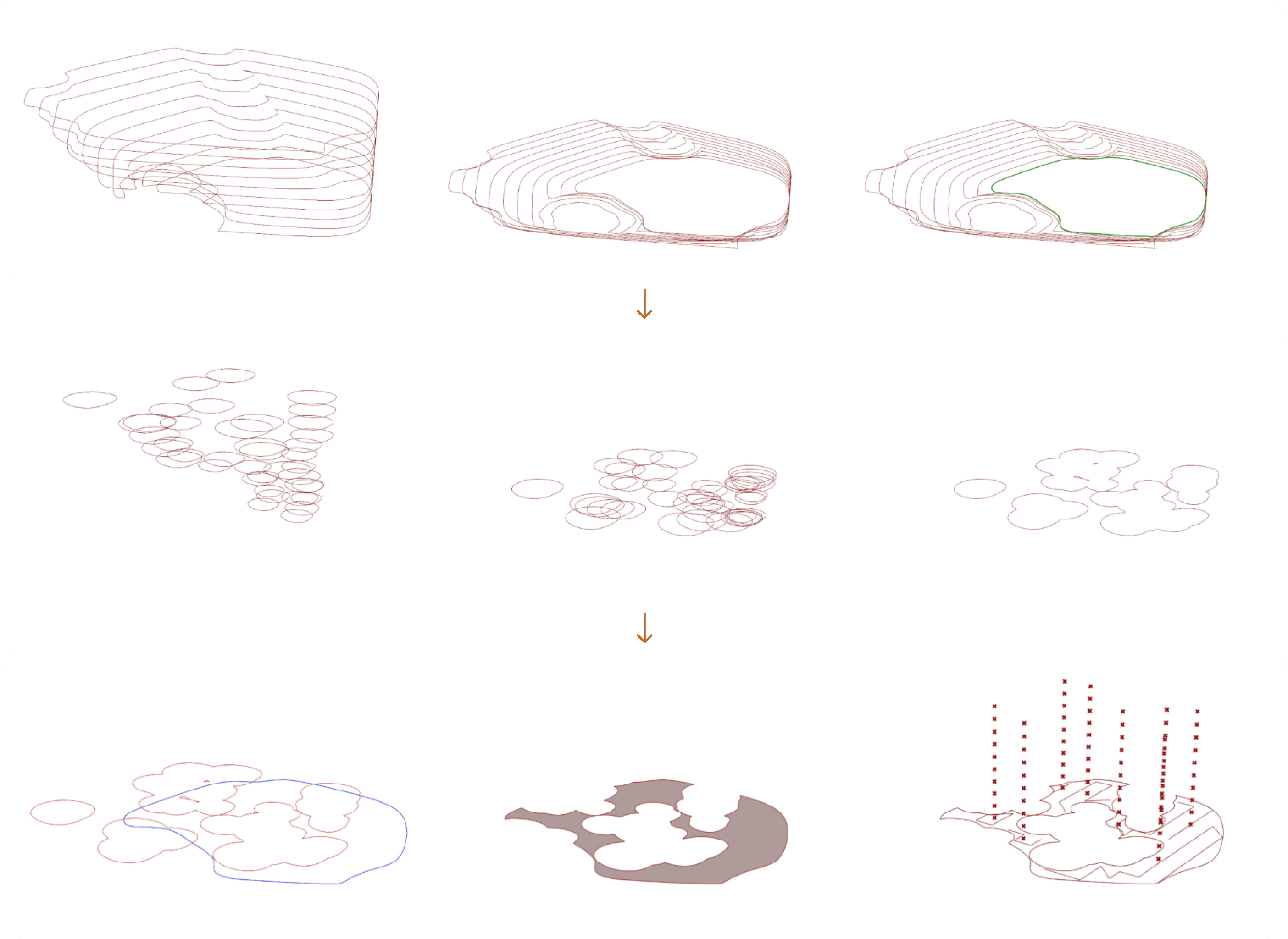
The massing strategy emerged from site-driven parameters:
- Attractor points and terrain informed overall volume
- Inner gardens and atriums were carved to introduce daylight and ventilation
- Floor plates were scaled and tapered to the slope
- Sun-path analysis guided the carving of solar-oriented voids, using a sun vector mine strategy
Void size and distribution varied by program, with residential floors receiving larger openings to maximize daylight and allow modular aggregation.
Modular Units
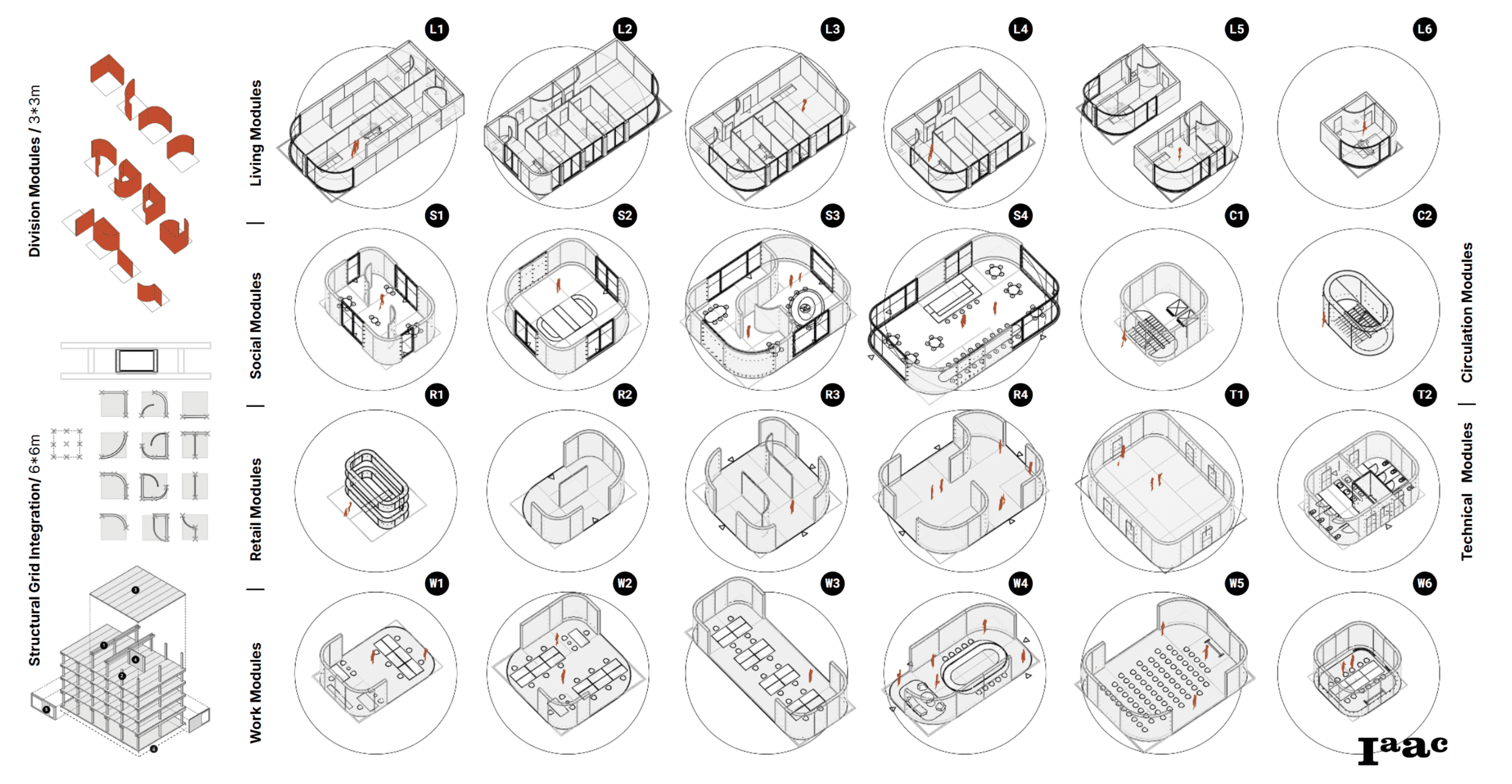
What this diagram says
The matrix is organised into living modules, social modules, retail modules and work modules across the rows, with circulation modules and technical modules grouped down the right edge. The left column shows division modules at 3m by 3m and structural grid integration at 6m by 6m.
Weekly model data was pulled straight out of the team’s shared model:
- Automated Python scripts extracted data from weekly Speckle model uploads
- Attribute flattening and targeted searches enabled reliable component-level data access
- Data was parsed into CSVs and processed using preset algorithms
- Metrics were calculated as absolute values and normalized scores, on a 0 to 1 scale
- 92 models processed through the pipeline
Circulation Logic
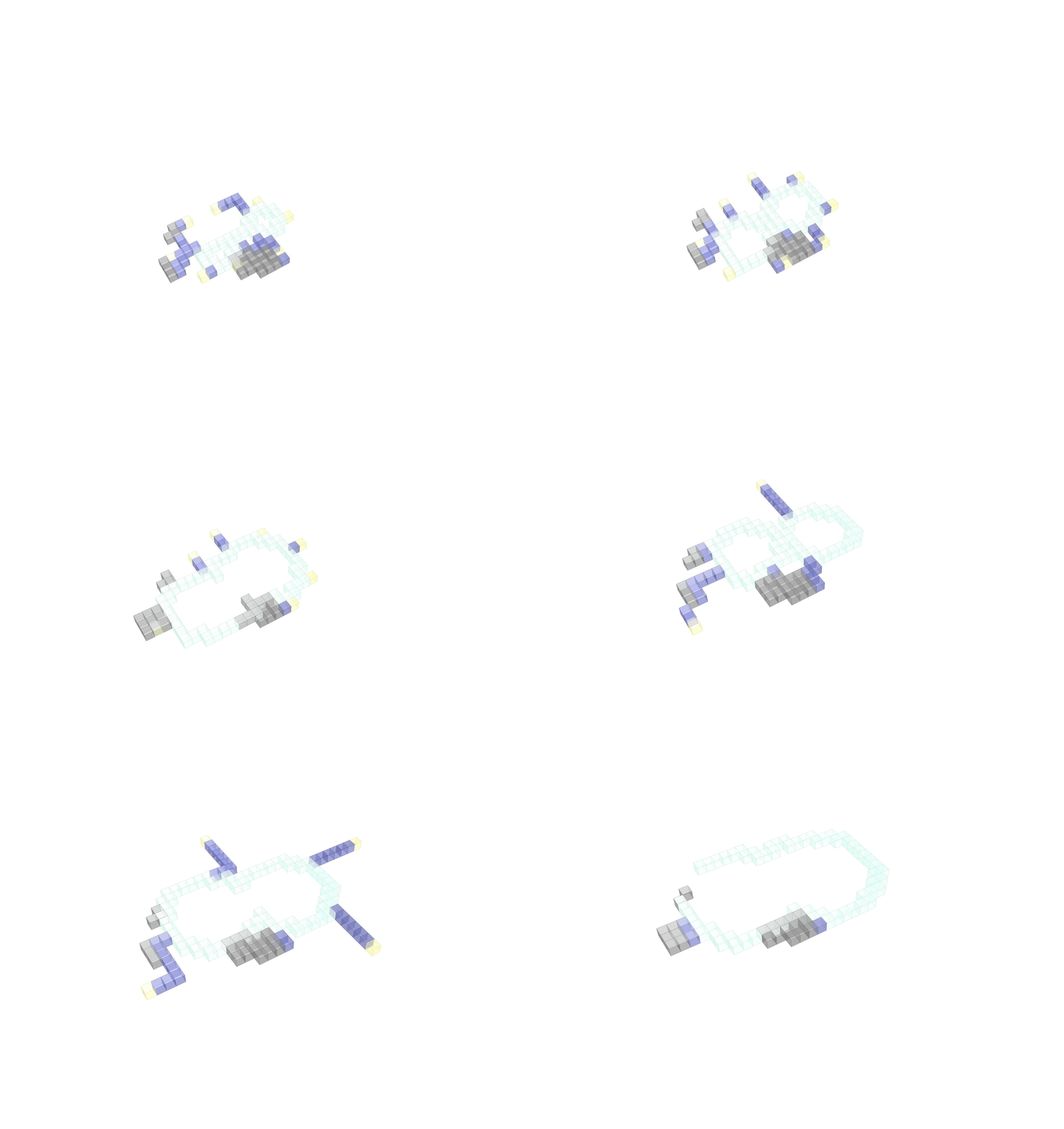
Horizontal circulation radiates from voids, forming continuous loops that link gathering spaces, corridors, and units. Vertical circulation is generated through parametric analysis of floor overlaps, producing:
- Full-height cores for egress and services
- Localized cores for residential or non-residential zones
This dual strategy balances efficiency, privacy, and programmatic hierarchy.
Modular Aggregation Algorithm
A custom Python-based aggregation algorithm was developed to overcome the limitations of existing Grasshopper tools. The system:
- Prioritized corridor-adjacent placements
- Tested multiple orientations per unit
- Enforced rules for entry alignment, daylight access, and non-overlap
- Placed larger modules first to optimize spatial efficiency
This iterative process generated diverse yet coherent layouts across floors.
Structural and Environmental Intelligence
Structural system
The primary structural framework is a mass timber grid, integrating:
- CLT floor slabs
- Glulam beams
- Modular partitions contributing to lateral resistance
A hybrid system combines mass timber with concrete and steel:
- Concrete cores provide lateral stability and house circulation
- A reinforced concrete foundation anchors the structure
- Lightweight modular partitions enable reconfiguration
This approach balances low carbon impact with structural robustness.
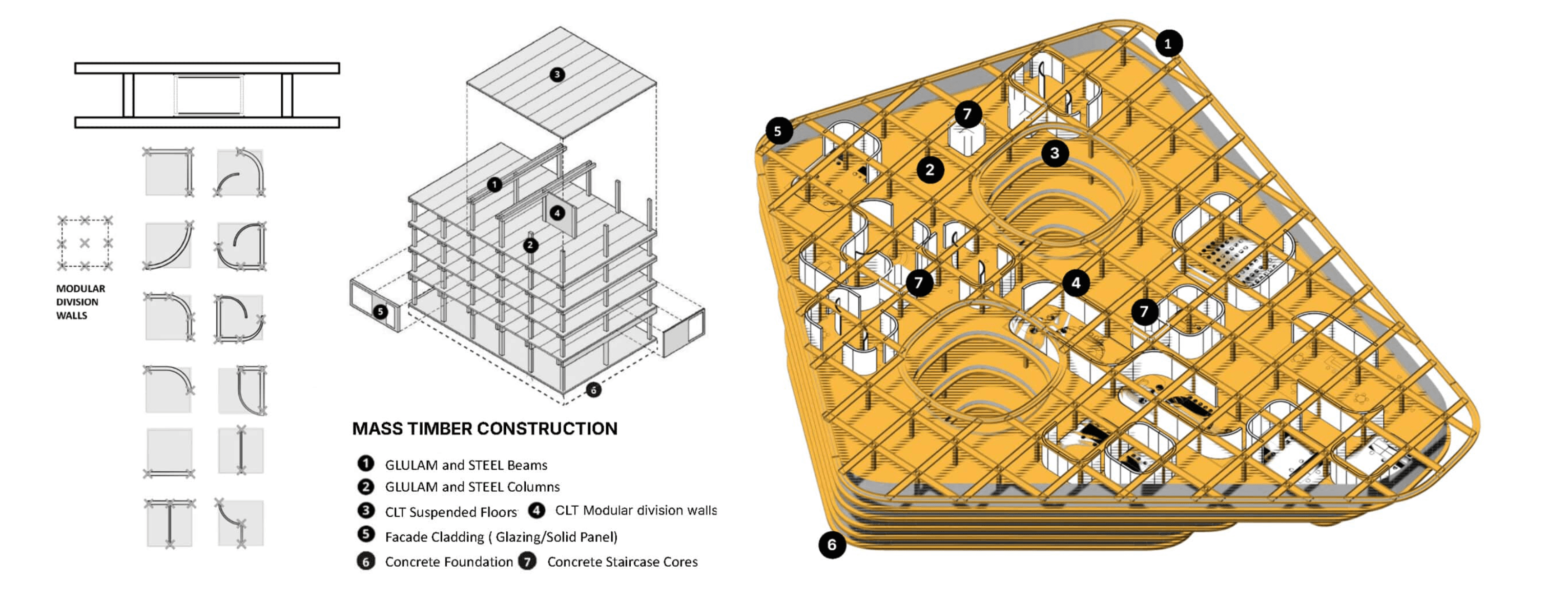
What this diagram says
The numbered callouts are glulam and steel beams, glulam and steel columns, CLT suspended floors, CLT modular division walls, facade cladding in glazing or solid panel, concrete foundation, and concrete staircase cores.
Structural optimization
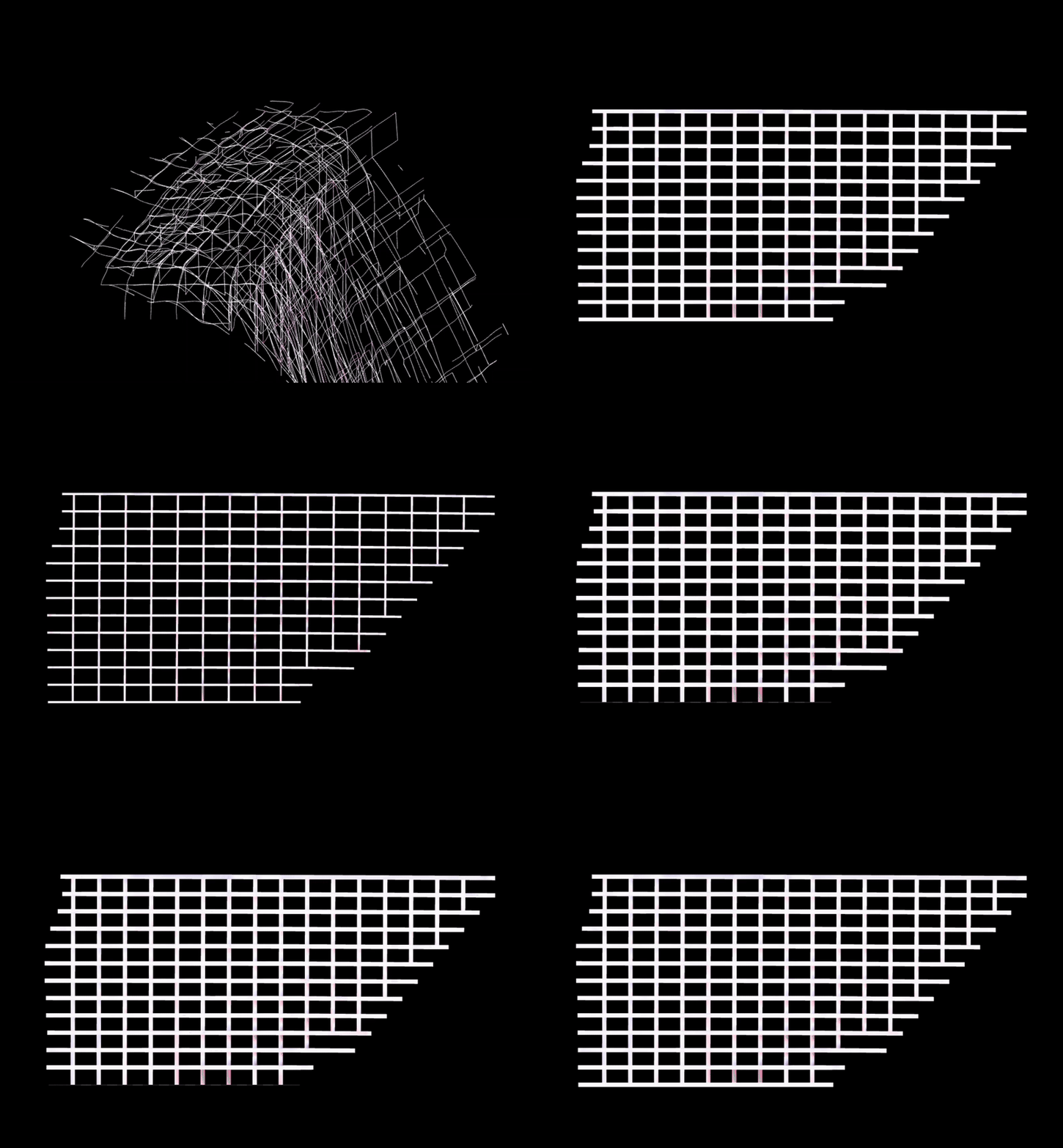
Structural performance was evaluated using Karamba, testing dead, live, wind, and gravity loads. A 9m by 9m grid emerged as an optimal balance, reducing displacement to 64 cm.
Multi-objective optimization with Opossum balanced:
- Cross-section utilization
- Deformation control
- Carbon footprint
Targeting 80% structural utilization ensured efficiency while preserving flexibility for future adaptation.
Facade strategy
Facade openings respond directly to internal aggregation. Canopies and voids are carved based on programmatic needs, creating variation across floors and establishing a clear relationship between internal function and external expression.
Circularity and energy analysis
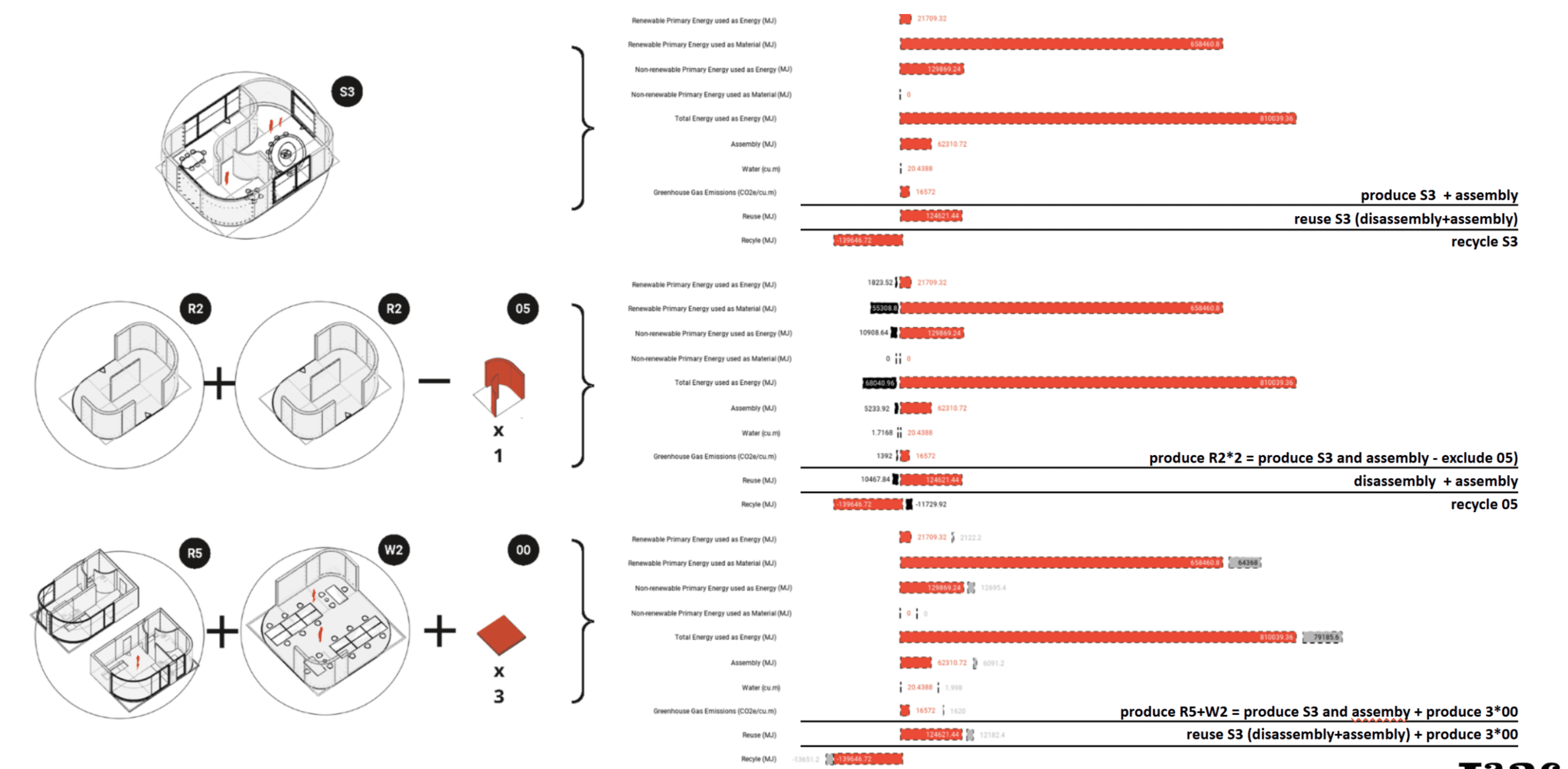
The project extends beyond form into circular construction strategies. Modular CLT units were evaluated as interchangeable components within a shared kit of parts. Comparative scenarios assessed:
- Embodied energy
- Greenhouse gas emissions
- Water usage
- Recyclability
Reused and adapted modules consistently reduced environmental impact compared to new construction, while maintaining programmatic flexibility.
Outcomes and Evaluation
The Perch demonstrates how computational design, modular systems, and structural optimization can produce buildings that are adaptable, sustainable, and resilient over time. By treating space as a configurable resource rather than a fixed outcome, the project offers a scalable framework for mixed-use urban development.
The Perch is not a single building, but a system for many possible buildings, designed to change without being rebuilt.
Project developed in collaboration with Seda Soylu and Scott Lebow for IAAC. You can read the original article on the IAAC blog.